Introduction to Piercing Aftercare
Proper aftercare is the foundation of a healthy healing process for any new ear piercing. Whether you’re excited about a fresh lobe stud or a bold cartilage piercing, the steps you take in the first weeks can make all the difference in preventing complications like piercing bumps or even a keloid scar. A piercing bump is a common, usually harmless response that can develop near the piercing site, but understanding the key differences in a piercing bump vs keloid is essential for protecting your skin.
The jewelry you choose plays a critical role—high quality jewelry made from implant grade titanium or surgical steel is far less likely to trigger irritation or allergic reactions compared to cheaper alloys. By investing in better jewelry and following a consistent aftercare routine, you significantly reduce the risk of developing piercing bumps or more serious raised scars. Remember, the goal is to support your body’s natural healing while minimizing trauma and inflammation at the piercing site. With proper aftercare, most new ear piercings heal smoothly, allowing you to enjoy your look without worry about bump vs keloid concerns down the line.
Quick Answer: Piercing Bump vs Keloid
Most raised bumps that appear near an ear piercing or nose piercing are harmless hypertrophic scars—localized tissue responses that stay small and often resolve with gentle cleaning and better jewelry. True keloids, however, are an abnormal, progressive overgrowth of dense scar tissue that extends well beyond the original piercing hole and rarely improves without structured intervention.
Here’s how to quickly self-check what you’re likely dealing with: piercing bumps usually appear within 2–4 weeks of a fresh piercing, stay confined to the immediate piercing site, and often flatten over time with consistent aftercare. Keloids tend to emerge months later (sometimes 3–12 months after the piercing seemed healed), spread beyond the original piercing wound, and continue growing slowly over weeks or years. A typical piercing bump feels soft or slightly squishy with mild tenderness when bumped, while a keloid scar feels firm, rubbery, and often causes persistent deep itching or tightness.
At HerbaScar, we specialize in raised scars—including both stubborn piercing bumps and true keloids—using botanical liquid extracts designed for deep tissue remodeling rather than surface-only care. If your bump is persistent, enlarging, or intensely itchy despite good hygiene, clinical-grade remodeling may offer relief where saline soaks and silicone gel sheets have fallen short.
Take a deep breath: many bumps are simply irritation-related and entirely reversible. But paying early attention to possible keloids leads to far better outcomes than waiting until the scar has doubled in size.
Introduction: Why Piercing Bumps Are So Confusing
Picture this: it’s 2025, and you got a helix cartilage piercing six weeks ago. The initial soreness faded, the redness calmed down, and you thought you were in the clear. Then one morning, you notice a little bump forming right at the piercing area—pinkish, slightly raised, and definitely not part of the original plan. Your first thought? Is this a keloid?
Not all bumps are created equal. An irritation bump triggered by sleeping on your new ear piercing is fundamentally different from a hypertrophic scar limited to the piercing channel, which is again distinct from a true keloid that aggressively invades surrounding skin. These three conditions look similar at first glance but have very different long-term behavior and treatment needs.
This article focuses on the critical distinction of piercing bump vs keloid using clear clinical criteria: onset time, growth pattern, borders, symptoms, and risk factors. Our goal is to help you identify what you’re dealing with and guide you toward the right response—whether that’s simple aftercare adjustments or professional scar management.
HerbaScar’s approach to raised scars is rooted in a 1907 Traditional Chinese Medicine scar-healing lineage, now enhanced with modern dermal remodeling science. Our botanical liquid extracts are designed to penetrate the dense collagen matrix of raised scars, including piercing-related keloids that have resisted other treatments. Throughout this guide, we’ll offer both medical-style guidance (when to see a dermatologist) and practical care strategies for protecting your skin.
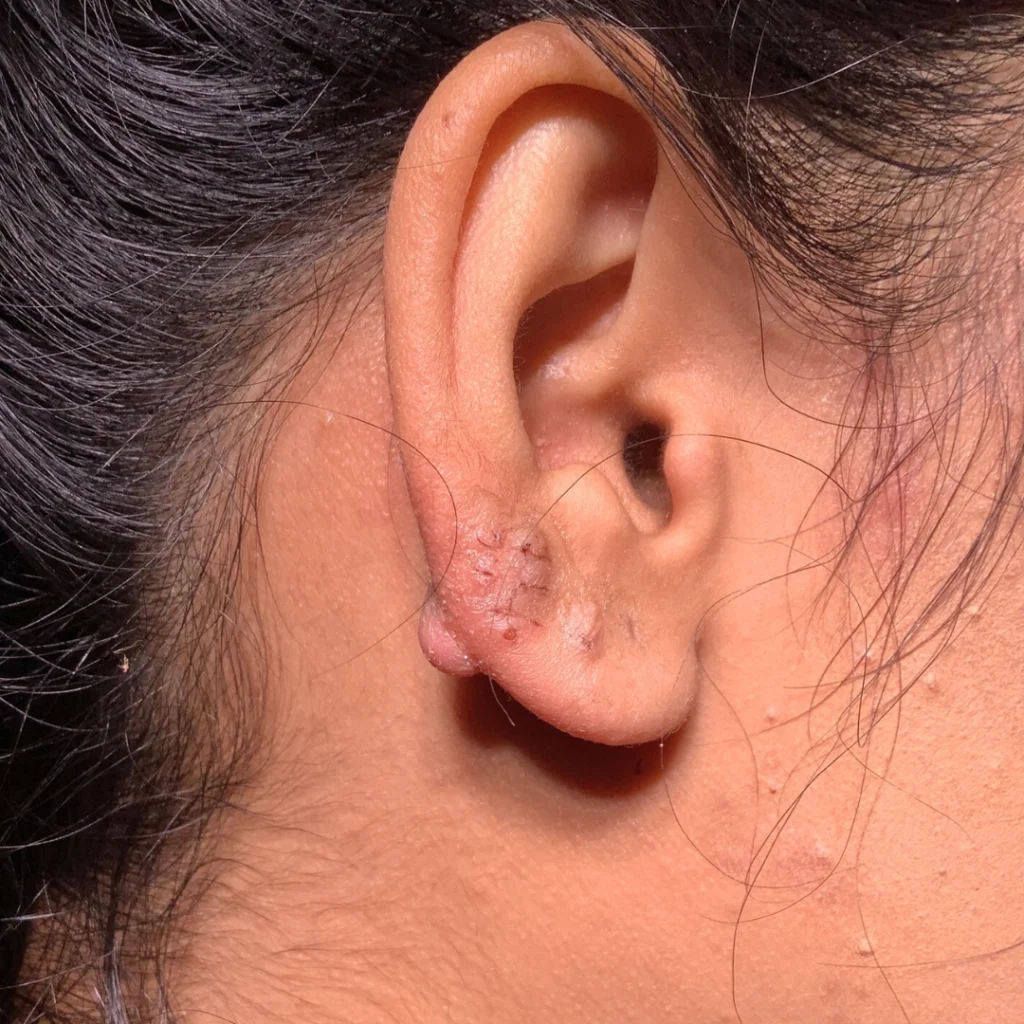
What Is a Piercing Bump (Hypertrophic Piercing Scar)?
A piercing bump is typically either a hypertrophic scar or an irritation nodule that remains limited to the piercing channel and the immediate surrounding rim. It represents the body’s natural response to the minor skin injury caused by piercing—a localized inflammatory reaction that produces slightly more tissue than necessary during the healing process.
Typical appearance characteristics:
- Small in size, often less than 5–6 mm across
- Pink, red, or skin-colored depending on your skin tone
- Slightly raised with a smooth or mildly bumpy surface
- Stays right at the edge of the piercing hole rather than spreading outward
Timing matters: Most piercing bumps develop within 2–6 weeks of a new piercing—whether that’s a soft earlobe, helix, tragus, or nostril piercing—while the piercing wound is still actively healing.
Common triggers include:
- Friction from tight backings or posts that compress the tissue
- Sleeping directly on the healing piercing night after night
- Low-quality metals containing nickel that cause allergic reactions
- Harsh cleaning products like rubbing alcohol or hydrogen peroxide that damage fragile healing tissue
- Minor physical trauma from snagging jewelry on clothing, hairbrushes, or towels
- Excessive touching with unwashed hands
The good news about a normal piercing bump is that it often stabilizes or slowly shrinks over 3–12 months with improved hygiene, better jewelry materials, and reduced irritation. Unlike keloids, piercing bumps tend to plateau rather than aggressively expand, and they rarely continue growing once you address the underlying trigger.
When photographing a simple piercing bump, you’d typically see a confined, rim-like bump hugging the piercing hole—not spreading into the surrounding skin or forming lobed masses.
What Is a Keloid Scar from a Piercing?
A keloid is an abnormal overgrowth of dense fibrous tissue resulting from an overactive fibroblast response. Unlike a hypertrophic scar that respects the boundaries of the original injury, a keloid scar extends well beyond the original piercing site, forming a raised, thick, often shiny scar mass that can become significantly larger than the initial piercing hole.
Typical keloid appearance:
- Firm, rubbery, or dense texture that feels immovable
- Dome-like, lobed, or irregularly shaped
- Clearly larger than the original piercing hole
- Often darker than surrounding skin—ranging from pink to red, brown, or purple depending on your skin tone
Timing: Keloids frequently develop weeks to many months after the piercing appears “healed”—typically between 3–18 months post-piercing. In some cases, a keloid’s appearance begins subtly, only becoming obvious once it has already grown substantially. Unlike piercing bumps that emerge during active healing, keloids tend to develop after the healing process seems complete.
Symptoms that distinguish keloids:
- Tightness around the affected area
- Burning sensations
- Deep, persistent itching that feels different from surface irritation
- Occasional sharp, nerve-like pain
- Tenderness when pressed or when jewelry pulls on the tissue
Risk factors for developing keloids:
- Family history of keloid formation
- Previous keloids from acne scars, surgical wounds, vaccinations, or burns
- Higher prevalence in individuals with darker skin (Fitzpatrick skin types IV–VI)
- Cartilage piercings (upper ear, tragus) versus soft lobe piercings
- Age between 10–30, when collagen activity is naturally higher
Unlike most piercing bumps, keloids rarely resolve on their own. They typically require medical interventions such as steroid injections, pressure earrings, laser treatment, or deep-penetrating scar liquids like HerbaScar™ Advanced Scar & Keloid Liquid to achieve meaningful softening and flattening.
Key Differences: Piercing Bump vs Keloid
Understanding the bump vs keloid distinction comes down to several observable characteristics. Here’s how to compare them across the most important criteria:
Size and spread: A piercing bump remains small and confined to the piercing margin—essentially a rim around the hole. A keloid grows beyond the original piercing site, sometimes forming a “mushroom” shape or ball that extends behind the ear or off the side of the nostril. If you can see raised scars spreading into skin that was never pierced, you’re likely looking at a keloid.
Onset timing: A typical piercing bump appears during early healing—usually the first 2–8 weeks after a new piercing. Keloid scars usually emerge later, often 3 months to 2 years after the initial piercing, frequently after repeated irritation or a secondary injury to the site.
Growth behavior: Piercing bumps may plateau in size or actually shrink with improved care. Keloids tend to expand slowly but relentlessly, sometimes doubling or tripling their original diameter over months or years if left unaddressed.
Texture and feel: An irritation bump or hypertrophic scar feels softer, sometimes slightly squishy, and moves slightly under gentle pressure. A keloid feels firm, rubbery, or dense, often with a tight, “corded” texture at its margins.
Symptom profile: A normal piercing bump may be slightly sore when accidentally bumped but isn’t deeply itchy. Keloids often cause persistent or intermittent deep itching, discomfort, tightness, and sensitivity to pressure—symptoms that interfere with daily life.
Reversibility: Most piercing bumps respond well to home care: saline soaks, jewelry changes, and irritation control. Keloids need structured, longer-term scar remodeling and often benefit from professional input from a dermatologist.
Quick summary:
- If you notice a small, soft bump that appeared in the first few weeks and isn’t expanding → think piercing bump
- If you notice a firm, spreading mass that appeared months later and keeps growing → think keloid
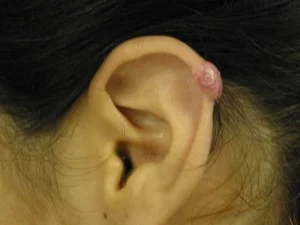
Other Conditions That Can Mimic Piercing Bumps or Keloids
Not every raised area at a piercing site is a scar. Some are infections or allergic reactions requiring entirely different management approaches.
Infection: An infected piercing typically shows redness spreading beyond the immediate piercing area, increasing pain rather than stable discomfort, warmth to the touch, and yellow or green pus discharge. In severe cases, you might experience fever or swollen lymph nodes. An infected piercing needs prompt medical attention—antibiotics, not scar treatments.
Contact dermatitis (allergic reaction): If you notice itchy redness, a rash, or tiny blisters specifically around your jewelry, you may be experiencing an allergic reaction to nickel, cobalt, or certain metal plating. This typically improves dramatically when you switch to hypoallergenic jewelry made from implant grade titanium or 18K+ gold.
Piercing granuloma: Sometimes a small, fleshy, moist, or crusted bump forms due to trapped sebum or repeated minor trauma rather than true excess collagen. These granulomas can look concerning but aren’t the same as hypertrophic scars or keloids.
When to seek medical attention immediately: If the piercing area is hot, very painful, or leaking thick pus, see a healthcare provider before focusing on scar treatments. Untreated infections can cause permanent damage and actually increase keloid risk due to prolonged inflammation.
A trained dermatologist or experienced professional piercer can usually distinguish between infection, allergy, hypertrophic scar, and keloid during a brief in-person examination. When in doubt, get expert eyes on the problem.
Who Is More Likely to Develop Keloids?
Genetics and skin biology play the primary role in determining whether a piercing bump will remain small or evolve into an aggressive keloid.
Ethnic and genetic factors: People of African, Caribbean, Latin American, Middle Eastern, South Asian, and East Asian heritage have statistically higher keloid prevalence. Individuals with darker skin tones (Fitzpatrick IV–VI) face elevated risk, though keloids can occur in anyone regardless of ethnicity.
Age considerations: Keloids are more common in teenagers and young adults, roughly ages 10–30, when natural collagen synthesis activity is at its peak. Hormonal factors during puberty and young adulthood may contribute to this increased susceptibility.
Anatomical sites: Certain body locations are more prone to keloid formation: chest, shoulders, upper back, and—critically for piercers—ear cartilage. Cartilage piercings heal more slowly than soft earlobe piercings, extending the inflammatory period and heightening keloid risk.
Personal history matters: Anyone who has developed previous keloids from acne, burns, surgery, or vaccinations should think carefully before getting cartilage piercings. If you fall into this category, discuss risks openly with both your piercer and a dermatologist before proceeding.
For high-risk individuals: Early, consistent scar management after piercing—using non-steroidal, deep-penetrating liquids, maintaining meticulous aftercare, and potentially using pressure jewelry—may help reduce the chance of thicker scar buildup. Prevention-focused care is far easier than treating an established keloid.
How to Know What You Have: Self-Check and Diagnosis
You can perform a simple self-assessment by considering four key factors:
- Timing: Did the bump appear in the first 2–6 weeks (suggesting irritation bump or hypertrophic scar) or months after the piercing seemed healed (suggesting possible keloid)?
- Borders: Is the bump confined to the piercing margin, or does it clearly extend into surrounding skin that was never pierced?
- Growth pattern: Has the bump stayed the same size or shrunk over the past month, or is it visibly larger than it was a few weeks ago?
- Symptoms: Is discomfort limited to occasional tenderness when touched, or do you experience persistent deep itching, tightness, or burning?
Monitoring approach: Track your bump over 4–6 weeks with consistent gentle cleaning. If it stays the same size or shrinks with proper aftercare, you’re almost certainly dealing with just a piercing bump. If it continues enlarging or begins forming lobes, suspect keloid.
When to see a dermatologist:
- The bump has persisted beyond 6–12 months without improvement
- The mass is larger than 1 cm across
- Growth continues despite excellent aftercare
- You’re experiencing severe pain, intense itching, or functional impairment
Diagnosis process: Dermatologists typically diagnose keloids clinically through visual examination and touch. In rare uncertain cases—particularly if the lesion looks unusual—a small punch biopsy may be performed to rule out other skin conditions.
Critical warning: Never attempt home “surgery” on suspected keloids. Cutting, tying thread around, or burning keloid tissue causes trauma that can trigger even more aggressive growth. Leave removal procedures to qualified medical professionals.
Aftercare Routine: Step-by-Step for New Piercings
A meticulous aftercare routine is your best defense against piercing bumps and other complications. Begin by always washing your hands thoroughly before touching your piercing area—this simple step helps prevent bacteria from entering the piercing site. Next, soak the area with a sterile saline solution for 5–10 minutes, two to three times daily. Saline soaks gently cleanse the piercing without disrupting the delicate healing tissue.
Avoid harsh chemicals like hydrogen peroxide or rubbing alcohol, as these can damage the skin and actually increase the risk of scar tissue formation. Instead, use a mild, fragrance-free soap and lukewarm water for gentle cleaning if needed. After cleaning, pat the area dry with a clean, disposable towel or paper product—never use shared or reused towels, which can harbor bacteria.
Minimize excessive touching or twisting of your jewelry, as this can introduce germs and cause unnecessary irritation. Consistency is key: regular saline soaks and gentle cleaning will help prevent piercing bumps and support a healthy healing process. By sticking to this aftercare routine, you give your piercing the best chance to heal beautifully and avoid complications.
Safe Care for a Piercing Bump (Non-Keloid)
Most simple piercing bumps can improve significantly with non-invasive, consistent care over several months. Here’s how to give your skin the best chance to heal:
Aftercare basics:
- Clean the piercing site twice daily with a sterile saline solution or pre-made wound wash
- Avoid rubbing alcohol, hydrogen peroxide, and harsh cleaners that damage fragile granulation tissue
- Use gentle cleaning motions rather than aggressive scrubbing
- Pat dry with clean, disposable paper products rather than shared towels
Jewelry adjustments:
- Switch to high quality jewelry made from implant grade titanium, surgical steel, or solid 14–18K gold
- Avoid nickel-containing alloys that trigger allergic reactions and inflammation
- Replace over-tight butterfly backs with flat-back labret studs that don’t compress tissue
- Ensure the bar or post length accommodates any swelling without pressing into skin
Lifestyle habits:
- Don’t sleep on the healing piercing—use a travel pillow with a hole if necessary
- Avoid headphones, helmets, or hats that press directly on the piercing area
- Stop twisting, spinning, or constantly touching the jewelry with unwashed hands
- Keep hair products, makeup, and perfume away from fresh piercings
For stubborn hypertrophic bumps: If a bump persists despite excellent hygiene and jewelry upgrades, non-steroidal remodeling liquids like HerbaScar™ Advanced Scar & Keloid Liquid can be introduced once the skin surface is fully closed (no open wound). Our transdermal liquid delivery system uses Borneol to bypass the epidermis and reach the dense collagen matrix where excess tissue formation occurs.
Realistic expectations: Even with ideal care, small hypertrophic bumps may take 2–6 months to fully flatten and fade. Consistency matters more than intensity—twice-daily gentle cleaning over months beats aggressive interventions that cause less irritation in the short term but more trauma overall.
What to Do If It’s Likely a Keloid
Discovering that your piercing has developed a keloid can feel disheartening—especially if you’ve already tried everything you read about online. We understand the frustration and want to help you approach this challenge calmly and effectively.
First, know that keloids are benign. They’re not cancerous and pose no threat to your overall health. However, they can be physically uncomfortable (that relentless itching, the tightness, the sensitivity) and cosmetically distressing. The good news: early, structured treatment tends to yield better control than waiting until the keloid has grown significantly.
Common medical treatment options:
- Intralesional corticosteroid injections: First-line medical treatment that can shrink keloids by 50–80% over 3–5 monthly sessions by curbing inflammation and collagen overproduction
- Silicone dressings or pressure earrings: Apply consistent compression to flatten raised tissue over time
- Laser treatment or light-based therapies: Can flatten and fade keloid tissue, though multiple sessions are typically required
- Cryotherapy: Freezes small lesions to reduce size, though this carries pigmentation risks for darker skin
- Surgical removal: Excises the keloid mass but has high recurrence rates (45–100% for ear keloids) unless combined with adjunct treatments like steroid injections or radiation therapy
The recurrence challenge: Simple surgical removal alone often results in keloids returning—sometimes larger than before. This is why combination approaches and long-term maintenance matter. Keloid management isn’t a one-time fix; it’s an ongoing relationship with your scar.
HerbaScar™ Advanced Scar & Keloid Liquid: For those seeking a non-steroidal, clinical-grade alternative, our Advanced Scar & Keloid Liquid was designed specifically for raised scars including piercing keloids. Using Borneol-driven transdermal penetration, this botanical liquid extract reaches the dermal root of the scar—the dense collagen matrix that surface creams cannot access.
Commitment to consistency: Keloid care usually requires months of daily application. Whether you’re using our deep-penetrating liquid extract, pursuing injections with a dermatologist, or combining approaches, consistency is non-negotiable. To track progress objectively, photograph your keloid monthly under the same lighting conditions. Visual documentation beats memory every time.
How HerbaScar Approaches Piercing Bumps and Keloids
HerbaScar represents a bridge between traditional herbal scar wisdom dating back to 1907 and modern dermatological science. Our focus: deep tissue remodeling rather than surface-only care that never reaches the true problem.
The liquid vs cream difference: Thick creams and onion-extract gels sit mostly on the epidermis—the outer skin layer—unable to penetrate the hardened collagen matrix of raised scars. HerbaScar’s clinical-grade liquid, powered by Borneol, is engineered for transdermal delivery directly into the dermis where keloid formation actually occurs.
The 3-Stage Remodeling Cycle:
Stage | What Happens | What You Notice |
|---|---|---|
Stage 1: Penetration & Softening | Active ingredients reach the dermal collagen matrix | Reduced tightness and itching |
Stage 2: Cellular Shedding | Collagen reorganizes; a natural medicated micro-scab may form and release | Visible flattening begins |
Stage 3: Protection & Prevention | Fresh skin emerges; formula supports continued remodeling | Smoother texture, reduced recurrence risk |
Key botanical ingredients:
- Borneol: The penetrator and itch reliever that drives transdermal delivery
- Panax Notoginseng: Softens dense fibrous tissue at the cellular level
- Galla Chinensis: Natural shrinking properties for raised scars
- Licorice Root Extract: Calms inflammation while brightening post-inflammatory pigmentation
All extracts undergo our 90-day cold fermentation process, shrinking botanical molecules to micro-level sizes while preserving maximum tissue-softening potency. No high heat, no harsh solvents.
Product matching:
- HerbaScar™ Advanced Scar & Keloid Liquid ($199): Best for raised piercing-related scars—both hypertrophic bumps and true keloids
- HerbaScar™ Chitosan Keloid Defense Gel: Use as a protective shield after the shedding stage or following in-clinic procedures to prevent recurrence
Safety profile: 0% steroids, 0% silicone, 0% parabens. Non-invasive. Cruelty-free. This is a premium, long-term remodeling solution—not a “miracle cure” or overnight promise. Real scar remodeling takes time and consistency.
Risk-free trial: We offer a 90-Day Empty Bottle Money-Back Guarantee because we understand you may have already spent money on products that failed. If HerbaScar doesn’t deliver the softening and flattening you’re looking for, you pay nothing.
Promoting Healthy Healing: Tips for Every Stage
Supporting your piercing through every stage of healing is essential for preventing piercing bumps and more serious issues like keloids. One of the most effective ways to prevent piercing bumps is to choose hypoallergenic jewelry—implant grade titanium or surgical steel are excellent options that minimize allergic reactions and irritation. Steer clear of harsh cleaning products, as these can disrupt the healing process and increase the risk of scar tissue.
Keep the piercing area clean and dry, and avoid submerging your piercing in pools, lakes, or hot tubs until it’s fully healed to prevent infection. If you notice any signs of severe pain, redness, swelling, or discharge, seek medical treatment promptly—early intervention can prevent complications from escalating. Most piercing bumps are temporary and respond well to gentle care, but persistent or worsening bumps may require professional evaluation, and in some cases, medical treatments like steroid injections or surgical removal.
By maintaining a consistent aftercare routine, using high quality, hypoallergenic jewelry, and being attentive to changes at your piercing site, you can promote healthy healing and reduce the risk of both piercing bumps and keloids. Remember, patience and gentle care are your best allies in achieving a smooth, complication-free healing process.
Prevention Tips: Reducing the Risk of Piercing Bumps and Keloids
The best approach to piercing bumps and keloids is preventing them in the first place. Here’s how to minimize your risk:
Choose your piercer wisely:
- Research reputable studios with documented sterile techniques
- Confirm they use single-use needles rather than piercing guns (especially for cartilage piercings—guns cause excessive trauma)
- Verify they stock starter jewelry made from implant grade titanium or equivalent hypoallergenic materials
- Ask about their aftercare protocol before committing
Consider your personal risk: If you have a known history of keloids from any source, avoid irritating high-risk sites like upper ear cartilage, sternum, or shoulders. Conservative placement on soft earlobes carries lower keloid risk.
Don’t change jewelry too early:
- Earlobes: wait at least 6–8 weeks
- Cartilage: wait 3–6+ months
- Nostril: wait 2–4 months
Premature jewelry changes introduce bacteria and cause trauma to incompletely healed tissue, increasing both infection and scarring risk.
Maintain consistent aftercare:
- Sterile saline solution twice daily for the first 3–6 months
- Keep heavy makeup, hair products, and perfumes away from the piercing site
- Minimize physical trauma from sleeping, sports, or tight clothing
- Avoid irritating the piercing with harsh chemicals or excessive touching
Prevention plan for high-risk individuals:
- Begin using non-steroidal remodeling support like HerbaScar once the surface wound is sealed
- Address any early bump formation immediately rather than hoping it resolves
- Schedule regular check-ins with a dermatologist if you have prior keloid history
- Consider pressure earrings during the healing period for ear piercings
When to See a Piercer vs a Dermatologist
Knowing who to consult can save time, money, and frustration.
See your professional piercer for:
- Jewelry that feels too tight or too short
- Questions about correct bar length for healing versus healed piercings
- Trapped or embedded backs
- Recommendations for safe jewelry materials (titanium, niobium, solid gold)
- Aftercare routine adjustments
See a dermatologist or doctor for:
- A fast-growing mass appearing months after initial healing
- Severe pain, tightness, or intense itching that interferes with daily life
- Repeated bleeding from the piercing site
- A scar that clearly extends beyond the original piercing site
- Any bump that hasn’t improved after 6+ months of good aftercare
Signs requiring urgent medical evaluation: Throbbing pain, spreading redness, significant pus discharge, and fever indicate possible infection. Don’t try DIY remedies—get professional medical treatment promptly.
Collaborative approach: The best outcomes often come from teamwork. Your piercer can adjust jewelry to reduce mechanical irritation while a dermatologist manages the biological aspects of keloid or hypertrophic scar treatment. Neither replaces the other.
Early expert input can help prevent complications and steer a fresh bump away from becoming a thick, permanent scar.
Conclusion: Listening to Your Skin and Acting Early
Most piercing bumps are temporary, limited, and totally manageable with consistent gentle care. True keloids, by contrast, are progressive growths that extend beyond the original piercing site and require structured remodeling over months.
The key differences come down to timing (weeks vs months), borders (confined vs spreading), growth pattern (stable vs expanding), and symptom intensity (mild tenderness vs deep itching and tightness). Learning to read these signals empowers you to respond appropriately—whether that means improving your aftercare routine or seeking professional evaluation.
Don’t ignore a mysterious bump that keeps enlarging month after month. Early intervention yields far better outcomes than waiting until a keloid has tripled in size. Seek both professional medical evaluation and appropriate scar remodeling support designed for raised scars.
HerbaScar exists as a long-term partner for those dealing with piercing bumps and keloids. Our botanical, deep-penetrating, clinical-grade liquid extracts—backed by a century of scar-healing tradition and modern dermatological research—offer a premium alternative when drugstore silicone sheets and surface creams have failed. With our 90-Day Empty Bottle Money-Back Guarantee, you can try true dermal remodeling risk-free.
Your skin deserves better than guesswork. Listen to it, act early, and choose scar care that actually reaches the problem.
FAQ: Piercing Bump vs Keloid
Can a small piercing bump turn into a keloid? In most cases, no. Simple irritation bumps and hypertrophic scars typically remain confined to the piercing margin and improve with proper care. However, in individuals genetically predisposed to keloids, ongoing inflammation or repeated trauma to a bump can potentially trigger true keloid formation. This is why consistent aftercare and avoiding irritating the bump is so important.
How long should I wait before assuming my bump is a keloid? If a bump appears within the first 2–8 weeks and stays the same size or shrinks over a few weeks with good care, it’s almost certainly not a keloid. If a raised mass emerges 3+ months after the piercing seemed healed and continues expanding over several weeks, that’s when keloid suspicion rises. Most dermatologists consider ongoing growth beyond 6–12 months despite proper care to be a strong indicator of keloid.
Is it safe to remove the jewelry if I suspect a keloid? Removing jewelry from an established keloid won’t make the keloid disappear—the fibrous tissue has already formed independently of the jewelry. However, keeping irritating or low-quality jewelry in place can worsen inflammation. Consult a dermatologist before removing jewelry, as the piercing channel may close and complicate future treatment. Sometimes switching to hypoallergenic jewelry is preferable to complete removal.
Why do steroid injections sometimes fail or cause recurrence? Corticosteroid injections work by suppressing collagen production, but the effect is temporary. Once injections stop, fibroblast activity may resume if the underlying genetic tendency remains active. Additionally, improper injection technique, insufficient treatment sessions, or inadequate follow-up care can contribute to recurrence. Many dermatologists now recommend combination approaches—injections plus ongoing topical remodeling or pressure therapy—for better long-term control.
Can I use home ingredients like tea tree oil or apple cider vinegar? We advise caution. Tea tree oil and apple cider vinegar are often too harsh for healing tissue and can cause chemical irritation that worsens both bumps and keloids. Over-irritating the skin triggers additional inflammatory responses, potentially feeding scar tissue growth. Stick to sterile saline solution for cleansing and evidence-based remodeling products for scar management.
How long should I use a remodeling liquid like HerbaScar Advanced Scar & Keloid Liquid? For piercing-related raised scars, consistency over at least one full collagen remodeling cycle is essential—typically 3–6+ months of daily application. Keloids in particular require sustained effort because their dense collagen matrix takes time to soften and reorganize. Many users continue maintenance application even after visible improvement to help prevent recurrence.
Is HerbaScar safe to try if I’ve had bad reactions to other products? HerbaScar™ Advanced Scar & Keloid Liquid contains 0% steroids, 0% silicone, and 0% parabens. It’s non-invasive and designed for sensitive, scarred skin. We also offer a 90-Day Empty Bottle Money-Back Guarantee, so cautious first-time users can try true dermal remodeling without financial risk. If the product doesn’t work for your skin, you get your money back—it’s that simple.
Leave a Reply