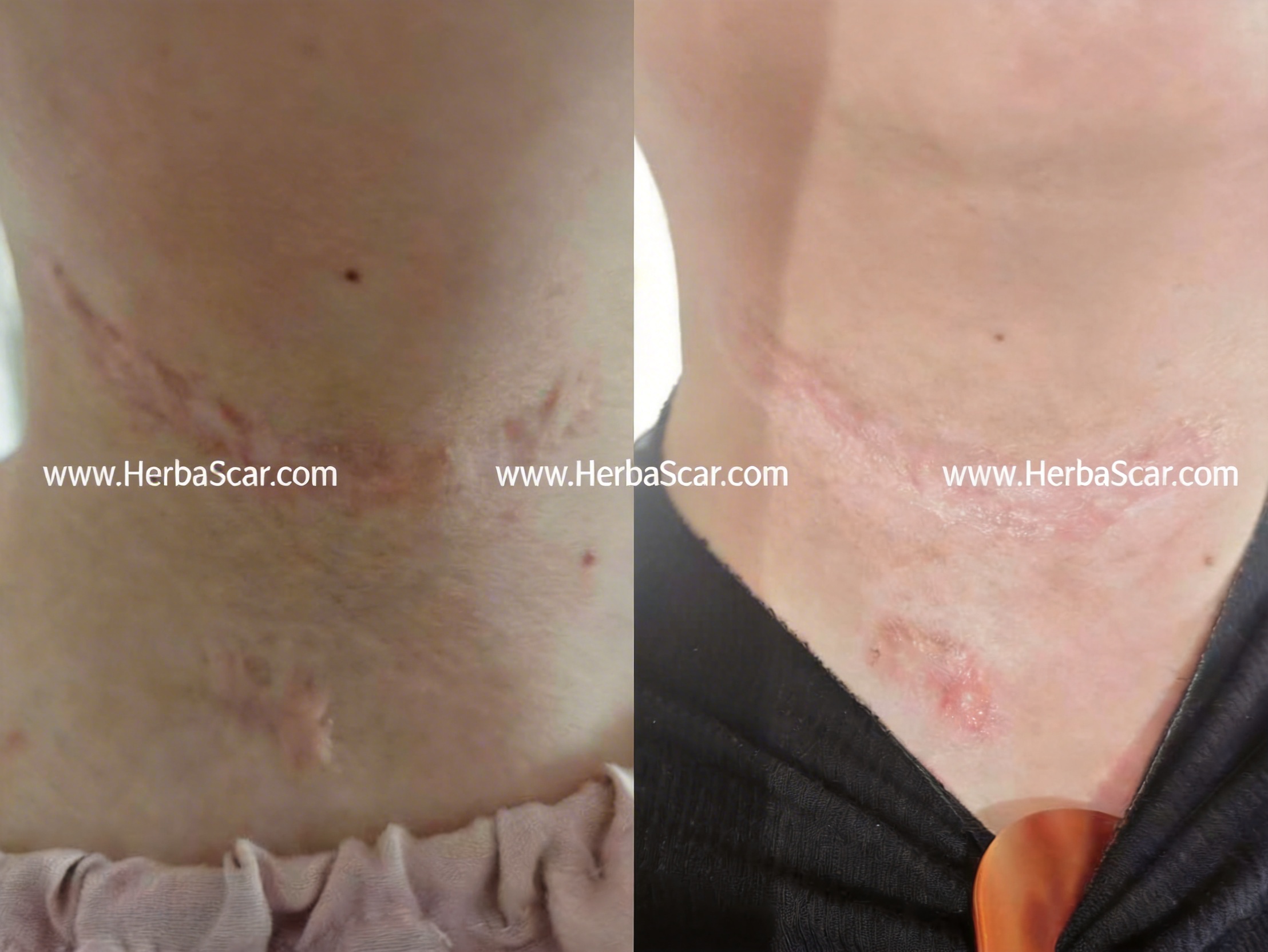
Post-surgical scars are a normal part of healing. In most cases, a surgical incision gradually fades and becomes less noticeable over time. However, for some patients the healing process becomes overactive, producing excess collagen and leading to a hypertrophic scar—a raised, firm, and often itchy line that remains visible long after surgery.
Hypertrophic scars commonly develop in areas with high skin tension, such as the neck, chest, shoulders, or joints. While treatments like silicone sheets, steroid injections, and laser therapy are widely used, some scars remain stubborn and resistant to conventional approaches.
The following case illustrates how a persistent thyroidectomy hypertrophic scar improved after several months of consistent topical treatment.
Patient Background and Symptoms
The patient was a licensed traditional Chinese medicine pharmacist in her early 30s who underwent thyroid surgery in 2017. The procedure left a horizontal incision across the lower neck.
During the first few months after surgery, the scar did not heal as expected. Instead of flattening and fading, the incision gradually became raised, firm, and dark red, forming a typical post-surgical hypertrophic scar.
Over time, several symptoms became increasingly bothersome. The scar felt tight and rope-like when she turned her head. It frequently itched, especially at night, and certain fabrics rubbing against the neck made the discomfort worse. Because the scar was located in a highly visible area, it also caused significant cosmetic concern.
Determined to improve the scar, she tried multiple treatment options. Over several years she underwent approximately ten sessions of laser therapy and used a variety of scar-reduction products, spending more than 12,000 RMB (about $1,600 USD) in total. Although these treatments produced minor changes, the scar remained noticeably raised and red.
Understanding Post-Surgical Hypertrophic Scars
To understand why scars like this develop, it helps to look briefly at the wound-healing process.
When skin is injured—whether by surgery, burns, or trauma—the body repairs the damage by producing collagen fibers. Normally, these fibers gradually reorganize and form a thin, flexible scar. However, in hypertrophic scars the healing response becomes overactive, producing too much collagen.
This excess collagen forms dense bundles of tissue, causing the scar to become thick, elevated, and sometimes itchy or painful. Unlike keloids, hypertrophic scars remain within the boundaries of the original wound, but they can still persist for years without proper management.
Certain areas of the body are more prone to hypertrophic scarring. The neck is one of them because it is constantly moving during speaking, swallowing, and head rotation. These repeated mechanical forces can stimulate collagen production and make scars more difficult to flatten.
Treatment Journey and Visible Changes
After years of frustration with limited results, the patient decided to try HerbaScar™ Advanced Scar & Keloid Liquid, a botanical topical formula designed for raised scars.
She applied the liquid twice daily to the scar line after cleansing the skin.
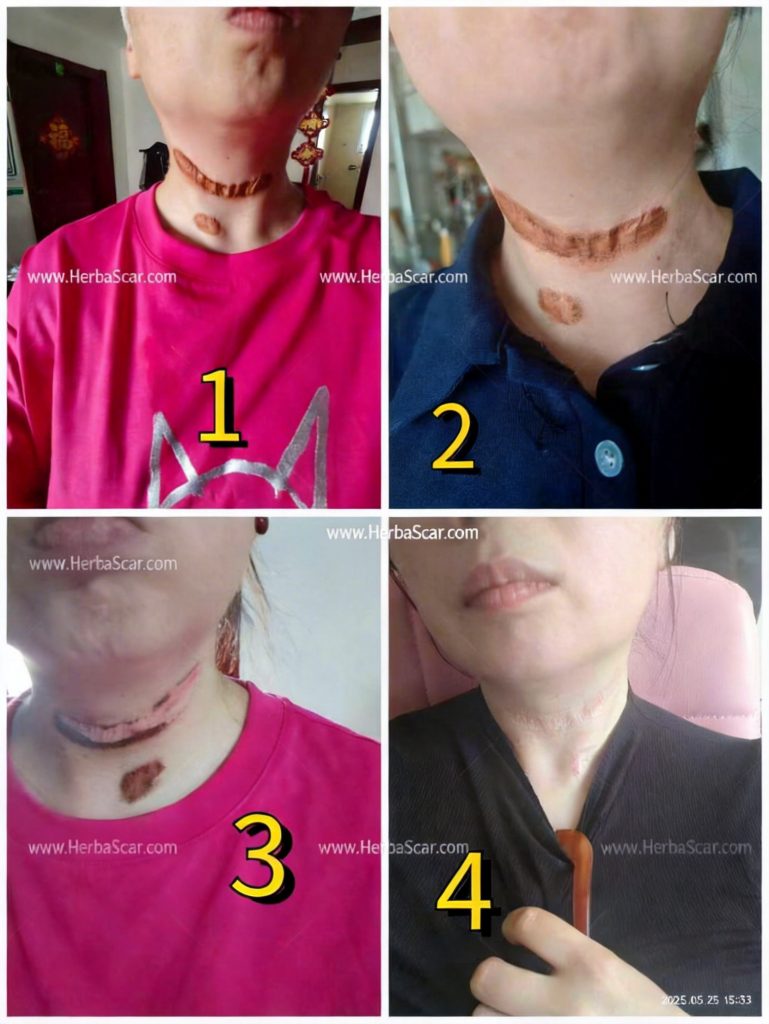
During the first month, the most noticeable change was a reduction in itching. Within the first couple of weeks, the persistent nighttime irritation began to ease. The scar also felt slightly softer to the touch, and the color gradually shifted from deep red toward a lighter pink.
By the second month, the texture of the scar continued to improve. The previously firm, rope-like tissue began to loosen, and the height of the scar visibly decreased. The surrounding skin appeared more even, and the scar line blended better with the neck.
After approximately three months of consistent use, the scar had become significantly flatter and less noticeable. The redness faded further, the tissue felt more flexible, and the patient reported feeling much more comfortable wearing open-collar clothing again.

While the scar did not disappear completely—as is typical with surgical scars—it became softer, flatter, and far less prominent.
Doctor’s Analysis: Why Improvement Was Possible
From a clinical perspective, hypertrophic scars persist because of excess collagen accumulation and reduced tissue remodeling within the dermis. Treatments that help soften dense collagen fibers and improve micro-circulation can gradually reduce scar thickness over time.
In traditional Chinese medicine theory, raised scars are often associated with “blood stasis”, meaning that circulation in the affected tissue becomes sluggish and the healing process stagnates. Certain botanical ingredients are traditionally used to stimulate circulation and support tissue remodeling.
The formula used in this case contains ingredients such as Panax Notoginseng, which is known for supporting micro-circulation, and Galla Chinensis, which is traditionally used to help shrink excess tissue growth. Combined with a liquid delivery system designed for better skin penetration, these ingredients may help soften hardened scar tissue and promote gradual remodeling.
It is important to note that scar improvement typically requires consistent treatment over several months. Hypertrophic scars develop slowly, and reversing the process also takes time.

This case demonstrates that even long-standing surgical scars may improve with persistent, targeted care and a treatment approach focused on softening collagen and supporting natural skin remodeling.
Leave a Reply